How many calories should you eat a day?
How many calories should you eat a day? Most adults need about 1,600–3,000 kcal. Here's how to estimate your own maintenance calories and a sensible deficit.
Most adults need somewhere around 1,600–2,400 kcal a day for women and 2,000–3,000 kcal a day for men, according to the estimates in the US Dietary Guidelines. Where you land depends on your age, body size and, above all, how active you are. For a personal number, estimate your resting energy use with the Mifflin-St Jeor equation, multiply it by an activity factor, then check the result against your real weight trend over a few weeks.
Average calorie needs by age, sex and activity
The Dietary Guidelines for Americans 2020–2025 give these estimates for adults. They aren't a prescription. They're a reasonable range for people of average height at a healthy weight.
| Age | Women, not active | Women, moderately active | Women, active | Men, not active | Men, moderately active | Men, active |
|---|---|---|---|---|---|---|
| 19–30 | 1,800–2,000 | 2,000–2,200 | 2,400 | 2,400–2,600 | 2,600–2,800 | 3,000 |
| 31–50 | 1,800 | 2,000 | 2,200 | 2,200–2,400 | 2,400–2,600 | 2,800–3,000 |
| 51+ | 1,600 | 1,800 | 2,000–2,200 | 2,000–2,200 | 2,200–2,400 | 2,400–2,800 |
"Moderately active" here means daily life plus walking about 1.5–3 miles (2.4–4.8 km) a day at 3–4 mph (about 5–6.5 km/h). "Active" means more than 3 miles a day. The tables are built around a reference body. In the 2010 edition that was a 5'10", 154 lb man (about 178 cm and 70 kg) and a 5'4", 126 lb woman (about 163 cm and 57 kg). If you're taller, heavier or more active than that, you'll likely need more.
Other organisations use different reference people and assumptions, so their headline numbers differ:
| Source | Typical adult figure |
|---|---|
| NHS (UK) | 2,000 kcal for women, 2,500 kcal for men |
| ICMR-NIN (India, 2020), sedentary | 1,660 kcal for a 55 kg woman, 2,110 kcal for a 65 kg man |
| ICMR-NIN (India, 2020), moderately active | 2,130 kcal for women, 2,710 kcal for men |
| FDA food labels | 2,000 kcal, used as a general reference for % Daily Value |
The 2,000 kcal on a food label is a yardstick for comparing foods, not a personal target.
How to calculate your maintenance calories
Your maintenance calories are what you'd eat to keep your weight steady. You can estimate them in two steps.
Step 1: resting energy. The Mifflin-St Jeor equation, published in 1990 from measurements of 498 healthy adults, estimates how much energy you burn at rest:
- Women: 10 × weight (kg) + 6.25 × height (cm) − 5 × age (years) − 161
- Men: 10 × weight (kg) + 6.25 × height (cm) − 5 × age (years) + 5
Step 2: multiply by your activity level. The FAO/WHO/UNU expert report on energy needs sorts lifestyles by physical activity level (PAL), which is total daily energy use divided by basal (resting) energy:
| Lifestyle | PAL | What it looks like |
|---|---|---|
| Sedentary or light activity | 1.40–1.69 | Desk job, getting around mostly by car, little exercise |
| Active or moderately active | 1.70–1.99 | A more physical job, or a desk job plus regular moderate to hard exercise |
| Vigorous | 2.00–2.40 | Several hours a day of hard physical work or training |
The report notes that a PAL above 2.40 is hard to keep up for long. If you're not sure where you fit, start near the low end of your band. You'll fine-tune it later anyway.
A worked example
Take two 35-year-olds who both weigh 70 kg: a woman who is 165 cm tall and a man who is 178 cm tall.
- Woman: 700 + 1,031 − 175 − 161 = about 1,395 kcal at rest
- Man: 700 + 1,112.5 − 175 + 5 = about 1,643 kcal at rest
Now multiply by a few activity levels:
| Activity (PAL) | Woman, 165 cm, 70 kg | Man, 178 cm, 70 kg |
|---|---|---|
| Mostly sitting (1.4) | ~1,950 kcal | ~2,300 kcal |
| Light activity (1.6) | ~2,230 kcal | ~2,630 kcal |
| Moderately active (1.85) | ~2,580 kcal | ~3,040 kcal |
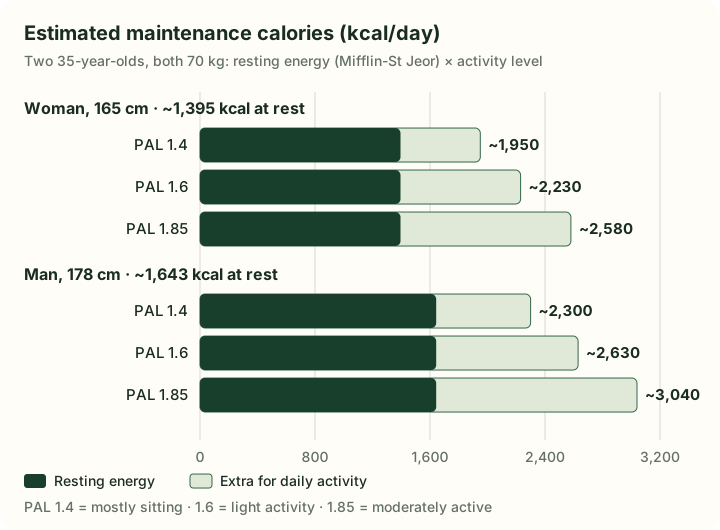
The man matches the Guidelines' reference body, and his sitting estimate of about 2,300 kcal is close to the 2,200–2,400 kcal the table gives a sedentary man aged 31–50. Notice how much activity moves the number: the gap between "mostly sitting" and "moderately active" is about 630–740 kcal a day, bigger than most diet changes people make.
How accurate are these numbers?
They're a good starting point, not a measurement. A 2005 systematic review in the Journal of the American Dietetic Association compared the common equations and found Mifflin-St Jeor the most likely to land within 10% of measured resting energy, in people both with and without obesity. The authors still warned of real errors for individuals, and noted that older adults and many ethnic groups were underrepresented in the studies behind the equations.
That matters outside the US too. India's ICMR-NIN found that the international FAO/WHO/UNU equations overestimated resting energy in Indians by about 10–12%, and its 2020 requirements trim the estimates to correct for that.
So treat your result as a first guess and let your body correct it:
- Eat around your estimate for 2–4 weeks and log your food as consistently as you can.
- Weigh yourself a few times a week, at the same time of day, and watch the weekly average.
- If the average holds steady, your intake is close to maintenance. If it drifts up or down, adjust by 100–200 kcal and check again.
Your log won't be perfect, and it doesn't need to be. Every food entry is really a range rather than an exact number, but the errors tend to repeat from day to day, so the trend is still useful.
How many calories should you eat a day to lose weight?
Start from your maintenance estimate and eat a bit less. The 2013 AHA/ACC/TOS obesity guideline lists a 500 or 750 kcal a day deficit as one evidence-based option, and the NHS suggests cutting about 600 kcal a day. The CDC describes losing about 1–2 lb (roughly 0.5–1 kg) a week as a gradual, steady pace, and says people who lose weight that way are more likely to keep it off.
For the woman in our example with light activity, a 500 kcal deficit means about 1,730 kcal a day. For the man, it's about 2,130 kcal a day.
Don't expect the scale to follow the old "3,500 calories = 1 pound" rule exactly. NIH researchers showed in 2011 that the rule overestimates weight loss because it ignores how your energy needs fall as you get lighter. Their rule of thumb for adults with overweight: for each pound you want to lose, permanently cut about 10 kcal a day (roughly 22 kcal per kg). Expect about half of that loss in the first year and nearly all of it by three years. Cutting 250 kcal a day, for example, leads to about 25 lb over time. The 3,500 rule would predict 26 lb in the first year alone and keep going.
That's also why progress slows over time and why it's worth recalculating every few kilograms. A slower pace isn't failure. The NHLBI suggests aiming for 5–10% of your starting weight over about 6 months, and notes that even 3–5% can improve blood sugar and triglycerides.
Very aggressive cuts are harder to keep up and make it harder to eat enough protein, fiber and micronutrients. If you're pregnant or breastfeeding, have diabetes or another medical condition, take medicine affected by eating less, or have a history of disordered eating, talk to a doctor or registered dietitian before changing how much you eat. Individual needs vary, and they can help you set a safe target.
From calories to macros
Once you have a calorie target, split it into macros. Set protein first (about 1.6 g per kg if you train, and up to 2.2 g/kg in a deficit; see how much protein you need), keep fat at about 20–35% of calories (how much fat per day), and let carbohydrates fill the rest (how many carbs per day). Aim for enough fiber and water along the way.
The takeaway
Use the Guidelines' 1,600–2,400 kcal (women) and 2,000–3,000 kcal (men) as a sanity check. For a personal number, work out your resting energy with Mifflin-St Jeor, multiply by an honest activity level, and then let a few weeks of real weigh-ins correct it. To lose weight, a steady deficit of around 500 kcal a day is a sensible, sustainable place to start.
Sources
- UMass Memorial Health: Eating the Right Number of Calories (Dietary Guidelines for Americans 2020–2025 table)
- Kansas State University: Estimated Calorie Needs per Day, from the Dietary Guidelines for Americans 2010 (PDF)
- NHS Better Health: Calorie counting
- ICMR-NIN: Nutrient Requirements for Indians 2020, brief note (PDF)
- FDA: The Lows and Highs of Percent Daily Value on the Nutrition Facts Label
- Mifflin MD, et al. A new predictive equation for resting energy expenditure in healthy individuals. American Journal of Clinical Nutrition, 1990
- FAO/WHO/UNU: Human energy requirements, Chapter 5 (2001)
- Frankenfield D, Roth-Yousey L, Compher C. Comparison of predictive equations for resting metabolic rate in healthy nonobese and obese adults: a systematic review. Journal of the American Dietetic Association, 2005
- MDedge: 2013 AHA/ACC/TOS guideline for the management of overweight and obesity in adults
- CDC: Steps for Losing Weight
- NIH News Release: NIH research model predicts weight with varying diet, exercise changes (2011)
- NHLBI: Aim for a Healthy Weight — Healthy Eating Plan
This article is general information, not medical advice. Talk to a qualified professional about your own health needs.