How much water should you drink a day?
How much water should you drink a day? Most adults need about 2–3.7 litres of total water, including what's in food. Here's what that means in glasses.
Most healthy adults need roughly 2 to 3.7 litres of total water a day, depending on whose guideline you follow, your size, how active you are and how hot it is. That figure includes the water in food, which usually supplies about a fifth of the total. So the amount you actually drink is typically around 1.6–3 litres — and for most people in a mild climate, drinking when you're thirsty and with meals gets you there without counting.
What the official guidelines say
There's no single global number. The European and US values are Adequate Intakes: amounts that healthy people generally consume and do fine on, rather than precise minimums.
| Source | Women | Men | What it covers |
|---|---|---|---|
| EFSA (Europe, 2010) | 2.0 L/day | 2.5 L/day | Total water: drinks + food |
| US National Academies (2004) | 2.7 L/day | 3.7 L/day | Total water: drinks + food |
| ICMR-NIN (India, 2024) | ~2 L/day | ~2 L/day | Water and other beverages, about eight glasses |
| NHS (UK) | 6–8 glasses | 6–8 glasses | Fluids, described as "just a guide" |
Why the gap between Europe and the US? The US figures are based on median intakes in a large national survey, while EFSA combined observed intakes with what's needed to keep urine at a healthy concentration. Both are best read as a comfortable range for healthy adults, and EFSA's values assume moderate temperatures and moderate activity.
How much water should you drink a day, in glasses?
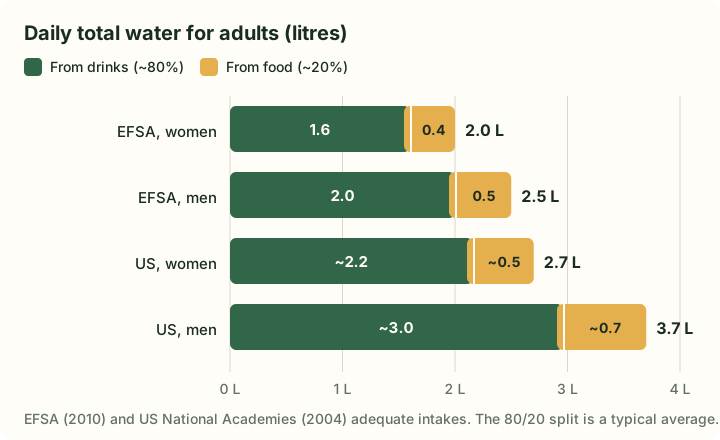
Because food covers part of your needs, the drinking target is smaller than the headline number. The US National Academies note that about 80% of total water comes from drinks and 20% from food. EFSA describes a similar split as a typical pattern. It's an average, not a rule: someone eating lots of fruit, vegetables, dal, soups and cooked grains will get more from food than someone living on dry snacks.
Applying that rough 80/20 split, and using a 250 mL glass:
| Guideline | Total water | From drinks (~80%) | 250 mL glasses |
|---|---|---|---|
| EFSA, women | 2.0 L | ~1.6 L | ~6 |
| EFSA, men | 2.5 L | ~2.0 L | ~8 |
| US, women | 2.7 L | ~2.2 L | ~9 |
| US, men | 3.7 L | ~3.0 L | ~12 |
A worked example
Take a moderately active 70 kg man in a mild climate. Using EFSA's 2.5 L, about 0.5 L would come from food, leaving roughly 2 litres to drink — around eight 250 mL glasses. Using the US figure of 3.7 L, he'd drink closer to 3 litres. If he spends a summer afternoon working outdoors or does a long, sweaty training session, his needs go up from there.
That's why the honest answer is a range, not a number. Like calorie targets, these are estimates that work best as ranges.
Where the "8 glasses a day" rule comes from
The "eight 8-ounce glasses" rule is everywhere, but it was never based on solid evidence. In a 2002 review, physiologist Heinz Valtin looked for scientific support for "8 × 8" and couldn't find any. He suggested it probably came from misreading an older US recommendation that went on to say most of that water is already in food.
A large 2022 study in Science backs this up. Researchers measured daily water turnover — all the water moving in and out of the body, from drinks, food and metabolism — in more than 5,600 people from 26 countries. Typical values ranged from about 1 to 6 litres a day. Physical activity and athletic status explained the biggest share of the differences, followed by sex, the country's level of development and age. Higher humidity and bigger bodies also pushed numbers up. The authors' point: a single cup count tells you very little about any one person.
Interestingly, India's 2024 guidelines still use "about eight glasses (approximately two litres)" — but that's meant to include other beverages, which brings it close to the European figures.
Do tea, coffee and milk count?
Yes. The US National Academies concluded that caffeinated drinks contribute to daily water intake about as well as non-caffeinated ones, because caffeine's diuretic effect appears to be short-lived. A 2014 crossover trial in 50 men who regularly drank coffee found that four 200 mL cups a day hydrated them about as well as the same amount of water, with no differences in body water or urine markers.
The NHS lists water, lower-fat milk and lower-sugar drinks, including tea and coffee, as counting toward your daily fluids. A few practical notes:
- Water is the simplest choice — it has zero calories, which matters if you're tracking intake.
- Sugary drinks count as fluid but add calories. The NHS suggests limiting fruit juice and smoothies to one small 150 mL glass a day.
- Keep caffeine moderate. ICMR-NIN advises staying under 300 mg of caffeine a day and avoiding tea and coffee for an hour either side of meals, because their tannins can reduce iron absorption.
- In hot weather, ICMR-NIN suggests buttermilk, tender coconut water or lemon water as good options.
When you need more (and when to be careful)
You'll generally need more fluid if you:
- Exercise hard or for a long time, or work in the heat
- Live somewhere hot or humid
- Are pregnant or breastfeeding — EFSA adds about 300 mL a day in pregnancy and about 700 mL while breastfeeding
- Are ill or recovering from an illness
- Are eating a lot more fiber — it works best with enough fluid
Two easy checks help. Thirst is a good guide for most healthy adults: EFSA notes that when water is freely available, people's intake over time tends to match their needs. And the NHS suggests aiming for pale yellow urine — though Valtin noted that darker urine on its own isn't a reliable sign of dehydration, so treat colour as a rough signal.
Thirst is less reliable in older adults, who may not feel thirsty even when they're short on fluid. Building drinks into routines — a glass with each meal, tea mid-morning — helps.
More is not always better. Drinking far beyond thirst, especially during long endurance events, can dilute blood sodium to dangerous levels (hyponatremia). A 2015 international consensus panel advised athletes to drink when thirsty rather than forcing fluids on a schedule.
Individual needs vary. If you have kidney, heart or liver disease, or you've been told to limit fluids, follow the advice of your doctor or a registered dietitian rather than general targets.
The takeaway
For most healthy adults, aim for roughly 1.6–3 litres of drinks a day on top of the water in your food — towards the lower end if you're smaller and in a cool climate, higher if you're bigger, active or in the heat. Drink with meals, drink when you're thirsty, let tea and coffee count, and top up on hot or sweaty days. You don't need to hit an exact number.
Sources
- National Academies: Report sets dietary intake levels for water, salt, and potassium (2004)
- EFSA: EFSA sets European dietary reference values for nutrient intakes (2010)
- EFSA Panel on Dietetic Products, Nutrition and Allergies. Scientific Opinion on Dietary Reference Values for water. EFSA Journal, 2010
- ICMR-National Institute of Nutrition: Dietary Guidelines for Indians (2024)
- NHS: Water, drinks and your health
- Valtin H. "Drink at least eight glasses of water a day." Really? Am J Physiol, 2002
- University of Wisconsin–Madison: Stop counting cups — there's an ocean of difference in our water needs (on Yamada Y, et al., Science, 2022)
- Killer SC, et al. No evidence of dehydration with moderate daily coffee intake. PLoS One, 2014
- Wolters Kluwer: Drink when thirsty to avoid fatal drops in blood sodium levels during exercise (Hew-Butler T, et al., Clin J Sport Med, 2015)
This article is general information, not medical advice. Talk to a qualified professional about your own health needs.