How much fat per day should you eat?
How much fat per day do adults need? Usually 20–35% of calories, about 44–78 g on 2,000 kcal, with saturated fat under 10%. Here's how to work out yours.
Most adults do well getting 20–35% of their daily calories from fat. On a 2,000 kcal diet, that's roughly 44–78 g of fat a day. The World Health Organization suggests keeping total fat at 30% of calories or less, and nearly every major guideline agrees on one more limit: keep saturated fat under 10% of calories, which is about 22 g on 2,000 kcal. Which fats you eat matters at least as much as the total.
What the guidelines say
The headline numbers come from a handful of official bodies. They overlap more than they differ:
| Source | Total fat | Saturated fat | Trans fat |
|---|---|---|---|
| US National Academies (AMDR, adults) | 20–35% of calories | As low as possible on a healthy diet | As low as possible |
| WHO (2023) | 30% of calories or less | No more than 10% | No more than 1% |
| Dietary Guidelines for Americans 2025–2030 | No numeric target | Less than 10% | — |
| ICMR-NIN (India, 2024) | 30% of calories or less | Limit | — |
| FDA Daily Value (food labels) | 78 g on 2,000 kcal | Less than 20 g | No Daily Value |
The US range is an Acceptable Macronutrient Distribution Range (AMDR): a band linked to lower chronic disease risk that still leaves room for enough essential nutrients. Infants and young children are the exception. They need a larger share, about 25–40% of calories from fat.
The FDA's 78 g is just the top of that range applied to 2,000 kcal (35% × 2,000 ÷ 9 ≈ 78 g). Its saturated fat figure of 20 g is a rounded-down version of the 10% limit.
How much fat per day for your calorie intake
Fat has about 9 kcal per gram, compared with about 4 kcal per gram for protein and carbohydrate. So to turn a percentage into grams:
Fat (g) = daily calories × percentage ÷ 9
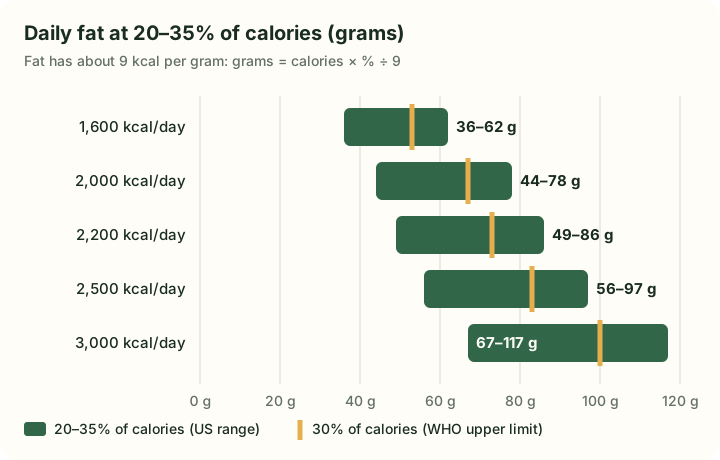
| Daily calories | 20% (low end) | 30% (WHO upper limit) | 35% (US upper end) | Saturated fat (under 10%) |
|---|---|---|---|---|
| 1,600 kcal | ~36 g | ~53 g | ~62 g | under ~18 g |
| 1,800 kcal | 40 g | 60 g | 70 g | under 20 g |
| 2,000 kcal | ~44 g | ~67 g | ~78 g | under ~22 g |
| 2,200 kcal | ~49 g | ~73 g | ~86 g | under ~24 g |
| 2,500 kcal | ~56 g | ~83 g | ~97 g | under ~28 g |
| 3,000 kcal | ~67 g | 100 g | ~117 g | under ~33 g |
A worked example
Take a 70 kg person eating about 2,200 kcal a day. Their fat range is roughly 49–86 g, and saturated fat should stay under about 24 g.
If they set protein first at 1.6 g/kg (see how much protein you need), that's 112 g, or 448 kcal. Choosing fat at 30% gives about 73 g, or 660 kcal. The remaining 1,092 kcal go to carbohydrate, which is about 273 g.
| Macro | Grams | Calories | Share of 2,200 kcal |
|---|---|---|---|
| Protein | 112 g | 448 kcal | ~20% |
| Fat | ~73 g | ~660 kcal | 30% |
| Carbohydrate | ~273 g | ~1,092 kcal | ~50% |
All three land inside the US ranges (protein 10–35%, fat 20–35%, carbs 45–65%). Someone who prefers more fat and fewer carbs could move fat toward 35%, and someone who prefers more carbs could drop toward 20–25%. Both are reasonable.
Can you eat too little fat?
Yes. Fat isn't just calories. Your body needs it to absorb the fat-soluble vitamins A, D, E and K, and it's part of every cell membrane. Two fats are essential, meaning you have to get them from food. The US Adequate Intakes for adults are:
- Linoleic acid (omega-6): 17 g/day for men, 12 g/day for women
- Alpha-linolenic acid (omega-3): 1.6 g/day for men, 1.1 g/day for women
Vegetable oils, nuts and seeds cover these easily on a normal diet. The 20% lower bound exists partly because going much lower makes it harder to meet those needs. If you're eating less to lose weight, it makes sense to cut back in grams but keep fat at around 20% of calories or more, rather than cutting it out.
Low-fat or low-carb?
For weight, the total calories you eat matter more than the fat-to-carb split. In the DIETFITS trial, published in JAMA in 2018, 609 adults were randomly assigned to a healthy low-fat or a healthy low-carb diet for a year. Average weight loss was 5.3 kg on low-fat and 6.0 kg on low-carb, and that difference wasn't statistically significant. Results varied a lot between individuals in both groups.
So pick the split you can stick with. Your fat target can flex with your preferences as long as protein and total calories stay where you want them.
The type of fat matters more than the total
Most guidelines now focus less on cutting total fat and more on swapping saturated and trans fats for better options:
- Unsaturated fats (olive, canola, peanut, sunflower and soybean oils, nuts, seeds, avocado, fatty fish) are the ones to favour. They're usually liquid at room temperature.
- Saturated fats (butter, ghee, fatty meat, cheese, coconut and palm oil) are best kept under 10% of calories. They're usually solid at room temperature.
- Trans fats (partially hydrogenated oils in some fried and packaged foods) are best kept as low as possible. The National Academies say no level is safe.
The evidence for the saturated fat swap comes largely from a 2020 Cochrane review of 15 randomised trials with about 56,700 participants. Cutting saturated fat for at least two years lowered the risk of combined cardiovascular events by about 17%, though it made little or no difference to deaths. Replacing saturated fat with polyunsaturated fat or with carbohydrate both looked helpful. WHO specifically suggests carbs from fibre-rich foods like whole grains, vegetables, fruit and pulses, which also help you reach your daily fiber target.
The 2025–2030 US Dietary Guidelines, released in January 2026, list full-fat dairy and even butter or beef tallow as fat options while keeping the under-10% saturated fat limit. Some clinicians have pushed back, including the authors of a Brown University Health review, pointing out that butter and tallow raise LDL cholesterol compared with liquid oils. Meanwhile WHO and the Cochrane evidence still favour unsaturated fats. We'd follow that majority view.
What a gram of fat looks like
Here's how some everyday foods compare (values from University Hospitals' nutrition tables; brands and cooking methods vary):
| Food | Total fat | Saturated fat | Calories |
|---|---|---|---|
| 1 tbsp olive oil | 13.5 g | 1.9 g | ~119 kcal |
| 1 tbsp butter | 11.5 g | 7.3 g | ~102 kcal |
| 28 g (1 oz) almonds | 14.4 g | 1.1 g | ~164 kcal |
| 1 large hard-boiled egg | 5.3 g | 1.6 g | ~78 kcal |
A tablespoon of butter carries about a third of a 2,000 kcal day's saturated fat budget. The same amount of olive oil has about a quarter as much.
Two tracking tips. First, cooking oil is the fat people most often forget to log. A tablespoon is over 100 kcal, so measure it rather than pouring it. Second, USDA researchers found that standard calorie factors overestimate the calories in some whole nuts, such as almonds and pistachios, because not all of their fat gets absorbed. It's one more reason to treat every logged number as a range, not an exact figure.
Reading fat on a label
On a US Nutrition Facts label, total fat, saturated fat and trans fat are listed separately. The %DV for total fat is based on 78 g and for saturated fat on 20 g. The FDA's rule of thumb is that 5% DV or less per serving is low and 20% DV or more is high. Trans fat has no %DV, so compare it by grams and aim for as close to zero as you can.
Individual needs vary. If you have high cholesterol, heart disease or another medical condition, or you've been given a specific fat target, follow the advice of your doctor or a registered dietitian.
The takeaway
Aim for 20–35% of your calories from fat, which is about 44–78 g on 2,000 kcal, and keep saturated fat under 10%. Within that range, choose what suits your tastes and lets you hit your protein and calorie goals. Most of your fat should come from oils, nuts, seeds and fish rather than butter, ghee and fatty meat, and measure your cooking oil.
Sources
- National Academies: Report offers new eating and physical activity targets to reduce chronic disease risk (Dietary Reference Intakes, 2002)
- WHO: WHO updates guidelines on fats and carbohydrates (2023)
- FDA: Interactive Nutrition Facts Label — Total Fat
- FDA: Interactive Nutrition Facts Label — Saturated Fat (PDF)
- Brown University Health: The 2025–2030 Dietary Guidelines and Heart Health — What to Know
- South First: ICMR releases Dietary Guidelines for Indians after 13 years (2024)
- Cochrane: Reduction in saturated fat intake for cardiovascular disease (Hooper L, et al., 2020)
- Gardner CD, et al. Effect of low-fat vs low-carbohydrate diet on 12-month weight loss (DIETFITS). JAMA, 2018
- Food Navigator: Low-carb versus low-fat diets equally effective, says study (on DIETFITS, 2018)
- USDA Agricultural Research Service: An improved method to estimate calories (AgResearch Magazine, 2013)
- Harvard Health: How many grams of fat can I eat each day as part of a healthy diet?
- University Hospitals: Nutrition Facts — olive oil, butter, almonds, egg
This article is general information, not medical advice. Talk to a qualified professional about your own health needs.