How many carbs per day should you eat?
How many carbs per day do adults need? Usually 45–65% of calories, about 225–325 g on 2,000 kcal, with a 130 g minimum. Here's how to work out your own.
Most adults do well getting 45–65% of their daily calories from carbohydrate. On a 2,000 kcal diet, that's about 225–325 g of carbs a day. The US minimum, the RDA, is 130 g a day. That's roughly what your brain needs in glucose, and it's a floor rather than a target. Where you land in the range depends on your calories, how active you are and what you like to eat. The type of carbs matters as much as the amount.
What the guidelines say
Official bodies phrase carb advice in different ways. Some give a percentage, some a minimum, and some talk only about food quality:
| Source | What it says about carbohydrate |
|---|---|
| US National Academies (adults) | 45–65% of calories, and at least 130 g/day (RDA) |
| EFSA (Europe) | 45–60% of energy, for adults and children |
| WHO (2023) | No percentage. Get carbs mainly from whole grains, vegetables, fruit and pulses |
| ICMR-NIN (India, 2024) | No more than 45% of calories from cereals and millets |
| Dietary Guidelines for Americans 2025–2030 | No total target. 2–4 servings of whole grains a day, and fewer refined carbs |
| FDA Daily Value (food labels) | 275 g on 2,000 kcal |
The 130 g RDA is based on the least amount of carbohydrate needed to make enough glucose for the brain. Most people eat far more than that without trying. The FDA's 275 g works out to 55% of a 2,000 kcal diet (275 × 4 = 1,100 kcal), right in the middle of the US range.
How many carbs per day for your calorie intake
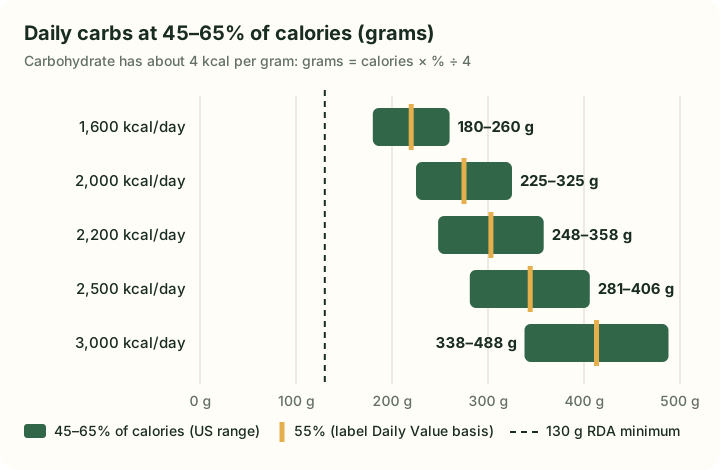
Carbohydrate has about 4 kcal per gram, the same as protein. To turn a percentage into grams:
Carbs (g) = daily calories × percentage ÷ 4
| Daily calories | 45% (low end) | 55% (middle) | 65% (high end) |
|---|---|---|---|
| 1,600 kcal | 180 g | 220 g | 260 g |
| 1,800 kcal | ~203 g | ~248 g | ~293 g |
| 2,000 kcal | 225 g | 275 g | 325 g |
| 2,200 kcal | ~248 g | ~303 g | ~358 g |
| 2,500 kcal | ~281 g | ~344 g | ~406 g |
| 3,000 kcal | ~338 g | ~413 g | ~488 g |
A worked example
Take a 70 kg person eating about 2,200 kcal a day. The easiest approach is to set protein and fat first and let carbs fill the rest.
At 1.6 g/kg (see how much protein you need), protein is 112 g, or 448 kcal. With fat at 30% (see how much fat per day), fat is about 73 g, or 660 kcal. That leaves 1,092 kcal for carbohydrate, which is about 273 g.
| Macro | Grams | Calories | Share of 2,200 kcal |
|---|---|---|---|
| Protein | 112 g | 448 kcal | ~20% |
| Fat | ~73 g | ~660 kcal | 30% |
| Carbohydrate | ~273 g | ~1,092 kcal | ~50% |
That's about 3.9 g of carbs per kg of body weight, and it sits comfortably inside the 45–65% range.
How many carbs if you're active?
Sports nutrition guidance sets carbs by body weight and training load rather than by percentage, because hard training burns through stored glycogen. These ranges come from the joint position of the Academy of Nutrition and Dietetics, Dietitians of Canada and the American College of Sports Medicine, as summarised by USADA:
| Training load | Carbs per kg per day | 70 kg person |
|---|---|---|
| Light (low intensity or skill-based) | 3–5 g | 210–350 g |
| Moderate (about 1 hour a day) | 5–7 g | 350–490 g |
| High (1–3 hours a day, moderate to hard) | 6–10 g | 420–700 g |
| Very high (4–5 hours a day) | 8–12 g | 560–840 g |
The 273 g in our example fits the light band. Someone training hard for an hour or more most days would usually need more food overall, and most of the extra would come from carbs.
How many carbs per day to lose weight?
There's no special carb number for fat loss. What matters most is eating somewhat less energy than you use, with enough protein to hold on to muscle.
The best evidence on this comes from a 2022 Cochrane review of 61 randomised trials with 6,925 adults with overweight or obesity. It compared low-carb diets (generally under 45% of calories, or 150 g a day or less) with balanced-carb diets (45–65%). In people without type 2 diabetes, the low-carb groups lost only about 1 kg more on average, both at 3–8.5 months and at 1–2 years. The authors described that as little to no difference. The DIETFITS trial, covered in our fat post, found much the same.
So pick the split you can keep up. If you prefer fewer carbs, that's a valid choice. Just know that definitions vary. StatPearls, for example, calls under 130 g a day (or under 26% of calories) low-carb, and 20–50 g very low-carb or ketogenic. If you take medicine for diabetes or blood pressure, talk to your doctor before cutting carbs sharply, because your treatment may need adjusting.
Carb quality: fiber and added sugar
Most guidelines now care more about where your carbs come from than about the exact total.
- Fiber: WHO recommends at least 25 g a day of naturally occurring fiber, and the US guideline is 14 g per 1,000 kcal. Whole grains, pulses, fruit and vegetables get you there. See how much fiber per day.
- Added and free sugars: WHO says to keep free sugars under 10% of calories, about 50 g on 2,000 kcal, and notes that going under 5% may bring extra benefit. ICMR-NIN also suggests under 5%. The FDA label still uses 50 g as the Daily Value for added sugars. The 2025–2030 US guidelines go further: they say no amount of added sugar is recommended, and if you do have some, keep it to 10 g or less per meal.
The exact limits differ, but every source points the same way. Build most of your carbs around whole grains, pulses, fruit and vegetables, and keep sugary drinks and sweets occasional.
What carbs look like in food
Here's the total carbohydrate in some everyday portions (values from University Hospitals' nutrition tables, based on USDA data; brands, varieties and cooking vary):
| Food | Total carbs | Fiber |
|---|---|---|
| 1 cup cooked white rice | ~45 g | ~0.6 g |
| 1 cup cooked lentils | ~40 g | ~15.6 g |
| 1 medium banana | ~27 g | ~3.1 g |
| 1 cup oatmeal, cooked with water | ~25 g | ~4.0 g |
| 1 medium apple, with skin | ~19 g | ~3.3 g |
| 1 slice whole-wheat bread | ~13 g | ~1.9 g |
Rice and lentils have similar carbs per cup, but lentils bring about 25 times the fiber and plenty of protein. As with every logged number, treat these as a range rather than an exact figure.
Reading carbs on a label
On a US Nutrition Facts label, total carbohydrate already includes dietary fiber, total sugars (with added sugars shown separately) and any sugar alcohols. The %DV is based on 275 g. The FDA's rule of thumb is that 5% DV or less per serving is low and 20% DV or more is high. Some packages and apps also show "net carbs", which usually means total carbs minus fiber. That figure isn't part of the Nutrition Facts label, so check how your app counts carbs before you compare numbers. European labels list fibre separately from carbohydrate, so you don't subtract it there.
Individual needs vary. If you have diabetes, kidney disease or another medical condition, or you've been given a specific carb target, follow the advice of your doctor or a registered dietitian.
The takeaway
For most adults, 45–65% of calories from carbs is a sensible range, which is about 225–325 g on 2,000 kcal. Stay above the 130 g minimum unless a professional advises otherwise. Set protein and fat first, let carbs fill the rest, and eat more if you train hard. Then focus on quality: plenty of fiber from whole grains, pulses, fruit and vegetables, and not much added sugar.
Sources
- National Academies: Report offers new eating and physical activity targets to reduce chronic disease risk (Dietary Reference Intakes, 2002)
- EFSA: EFSA sets European dietary reference values for nutrient intakes (2010)
- WHO: WHO updates guidelines on fats and carbohydrates (2023)
- WHO: Healthy diet fact sheet
- South First: ICMR releases Dietary Guidelines for Indians after 13 years (2024)
- American Family Physician: Dietary Guidelines for 2025–2030 — Recommendations From the USDA and HHS
- Harvard T.H. Chan School of Public Health: Dietary Guidelines for Americans 2025–2030 — progress on added sugar, protein hype, saturated fat contradictions
- FDA: Interactive Nutrition Facts Label — Total Carbohydrate
- Naude CE, et al. Low-carbohydrate versus balanced-carbohydrate diets for reducing weight and cardiovascular risk. Cochrane Database of Systematic Reviews, 2022
- Oh R, Gilani B, Uppaluri KR. Low-Carbohydrate Diet. StatPearls (NCBI Bookshelf)
- Position of the Academy of Nutrition and Dietetics, Dietitians of Canada, and the American College of Sports Medicine: Nutrition and Athletic Performance (2016)
- USADA: Nutrition guide for athletes (PDF)
- University Hospitals: Nutrition Facts — rice, lentils, banana, oatmeal, apple, whole-wheat bread
This article is general information, not medical advice. Talk to a qualified professional about your own health needs.