How much fiber per day do you actually need?
How much fiber per day do adults need? About 25–38 g depending on age and sex, or 14 g per 1,000 kcal — plus an easy sample day that gets you there.
Most adults should aim for roughly 25–38 g of fiber per day. The US recommendation is 14 g for every 1,000 kcal you eat, which works out to about 38 g for men and 25 g for women up to age 50. The World Health Organization and the European Food Safety Authority both set a simpler floor of at least 25 g a day for adults. Most people fall well short of either number.
The official numbers
Different bodies phrase it differently, but they land in the same neighbourhood:
| Source | Recommendation for adults |
|---|---|
| US National Academies (Adequate Intake) | 14 g per 1,000 kcal |
| Men, 50 and younger | 38 g/day |
| Women, 50 and younger | 25 g/day |
| Men, over 50 | 30 g/day |
| Women, over 50 | 21 g/day |
| FDA Daily Value (Nutrition Facts label) | 28 g/day |
| WHO (2023) | at least 25 g/day of naturally occurring fiber |
| EFSA (Europe) | 25 g/day, enough for normal bowel function |
The numbers for older adults are lower mainly because people tend to eat fewer calories as they age, and the US figure is tied to calories. The FDA's 28 g is simply the 14 g per 1,000 kcal rule applied to a 2,000 kcal reference diet.
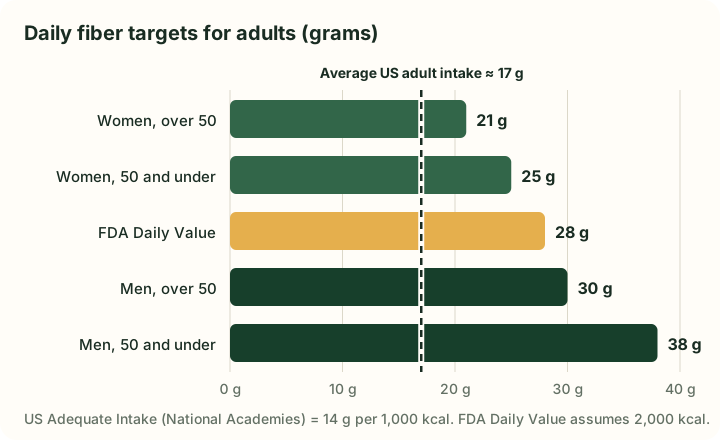
For comparison, the average American adult eats only about 17 g a day, and an estimated 94% of US children and adults don't reach the recommended intake. Fiber is a nutrient most people could do with more of.
How much fiber per day for your calorie intake
If you already track calories, the easiest way to set a fiber target is to scale it to what you eat:
Fiber target (g) = daily calories ÷ 1,000 × 14
| Daily calories | Fiber target |
|---|---|
| 1,600 kcal | ~22 g |
| 1,800 kcal | ~25 g |
| 2,000 kcal | 28 g |
| 2,500 kcal | 35 g |
| 3,000 kcal | 42 g |
So a 70 kg person eating around 2,200 kcal a day would aim for about 31 g (2.2 × 14 = 30.8). If you're eating less to lose weight, your target drops a little too — but it's worth not letting it fall below the 25 g floor that WHO and EFSA use, because fiber helps meals feel more filling.
Like every number you log, these are estimates. Fiber values on labels and in databases vary with brand, ripeness and cooking, so treat your daily total as a range rather than an exact figure.
Why it's worth hitting the target
Fiber is the part of plant foods your small intestine can't digest. It comes in two broad types, and most plant foods contain a mix of both:
- Soluble fiber (oats, beans, lentils, apples, citrus) dissolves in water and forms a gel. It slows digestion, can blunt blood sugar rises after meals, and helps modestly lower LDL cholesterol.
- Insoluble fiber (wheat bran, whole grains, nuts, the skins of fruit and vegetables) doesn't dissolve. It adds bulk to stool and helps keep things moving.
The strongest evidence on long-term health comes from a large 2019 set of meta-analyses in The Lancet, commissioned by WHO, which pooled about 135 million person-years of data from prospective studies plus 58 clinical trials. People with the highest fiber intakes had about 15% lower all-cause mortality and roughly 16–31% lower rates of heart disease, stroke, type 2 diabetes and colorectal cancer than those with the lowest intakes. The benefits were greatest at 25–29 g a day, and the data suggested that eating more than that may help further.
These are mostly observational findings, so they show an association rather than proof that fiber alone causes the difference. Still, the clinical trials in the same review found that eating more fiber led to small but significant drops in body weight, systolic blood pressure and total cholesterol, which fits the picture.
A sample day with 30+ grams
You don't need special products to get there. Here's an ordinary day using fiber values from the US Dietary Guidelines' food tables (based on USDA data):
| Meal | Food | Fiber |
|---|---|---|
| Breakfast | ½ cup oat bran + 1 tbsp chia seeds + 1 medium banana | 2.9 + 4.1 + 3.2 = 10.2 g |
| Lunch | 2 small whole-wheat rotis (about 28 g each) + ½ cup cooked lentils | 5.6 + 7.8 = 13.4 g |
| Snack | 1 medium apple, with skin | 4.8 g |
| Dinner | 1 cup cooked broccoli alongside your usual meal | 5.2 g |
| Total | 33.6 g |
That clears the 28 g Daily Value and sits comfortably in the 25–38 g range. Other easy wins from the same tables:
- 1 cup raspberries: 8.0 g
- ½ cup cooked black beans: 7.5 g
- ½ cup cooked chickpeas: 6.3 g
- 1 medium pear: 5.5 g
- 3 cups popcorn: 5.8 g
- 1 oz (28 g) almonds: 3.5 g
Pulses — lentils, beans, chickpeas, split peas — are the heavy hitters, with around 6–10 g per half cup cooked. They also bring protein, which helps if you're working toward a higher protein target.
Reading fiber on a label
On a US Nutrition Facts label, dietary fiber is listed under total carbohydrate, with a %DV based on 28 g. The FDA's rule of thumb: 5% DV or less per serving is low, and 20% DV or more is high. That means a serving with about 5.6 g or more of fiber counts as a high-fiber food.
On US labels, fiber is already counted inside total carbohydrate, so you don't add it on top when logging macros. European labels list fibre separately from carbohydrate, so check which convention your tracking app uses.
Increase it slowly
If you currently eat around 15 g, jumping straight to 35 g is a fast route to gas, bloating and cramps. A gentler approach is to add 2–3 g every few days and drink enough fluid as you go, since fiber works best with water. The discomfort usually settles as your gut gets used to the extra fiber.
Individual needs vary. If you have a digestive condition such as IBS or inflammatory bowel disease, or you've been told to follow a low-fiber diet, check with your doctor or a registered dietitian before making big changes.
The takeaway
Aim for at least 25 g of fiber a day, or about 14 g per 1,000 kcal if you track calories. Log a few normal days to see where you are, then add one high-fiber food at a time — a portion of beans or lentils, a piece of fruit with the skin on, a whole-grain swap — until you're consistently in range.
Sources
- National Academies: Report offers new eating and physical activity targets to reduce chronic disease risk (Dietary Reference Intakes, 2002)
- WHO: WHO updates guidelines on fats and carbohydrates (2023)
- EFSA: Public consultation on Dietary Reference Values for carbohydrates, dietary fibre and fat (2009)
- FDA: Daily Value on the Nutrition and Supplement Facts labels
- Reynolds A, et al. Carbohydrate quality and human health: a series of systematic reviews and meta-analyses. The Lancet, 2019
- The Role of Dietary Fiber in Health Promotion and Disease Prevention: A Practical Guide for Clinicians (StatPearls, NCBI Bookshelf)
- Dietary Guidelines for Americans: Food sources of dietary fiber
This article is general information, not medical advice. Talk to a qualified professional about your own health needs.